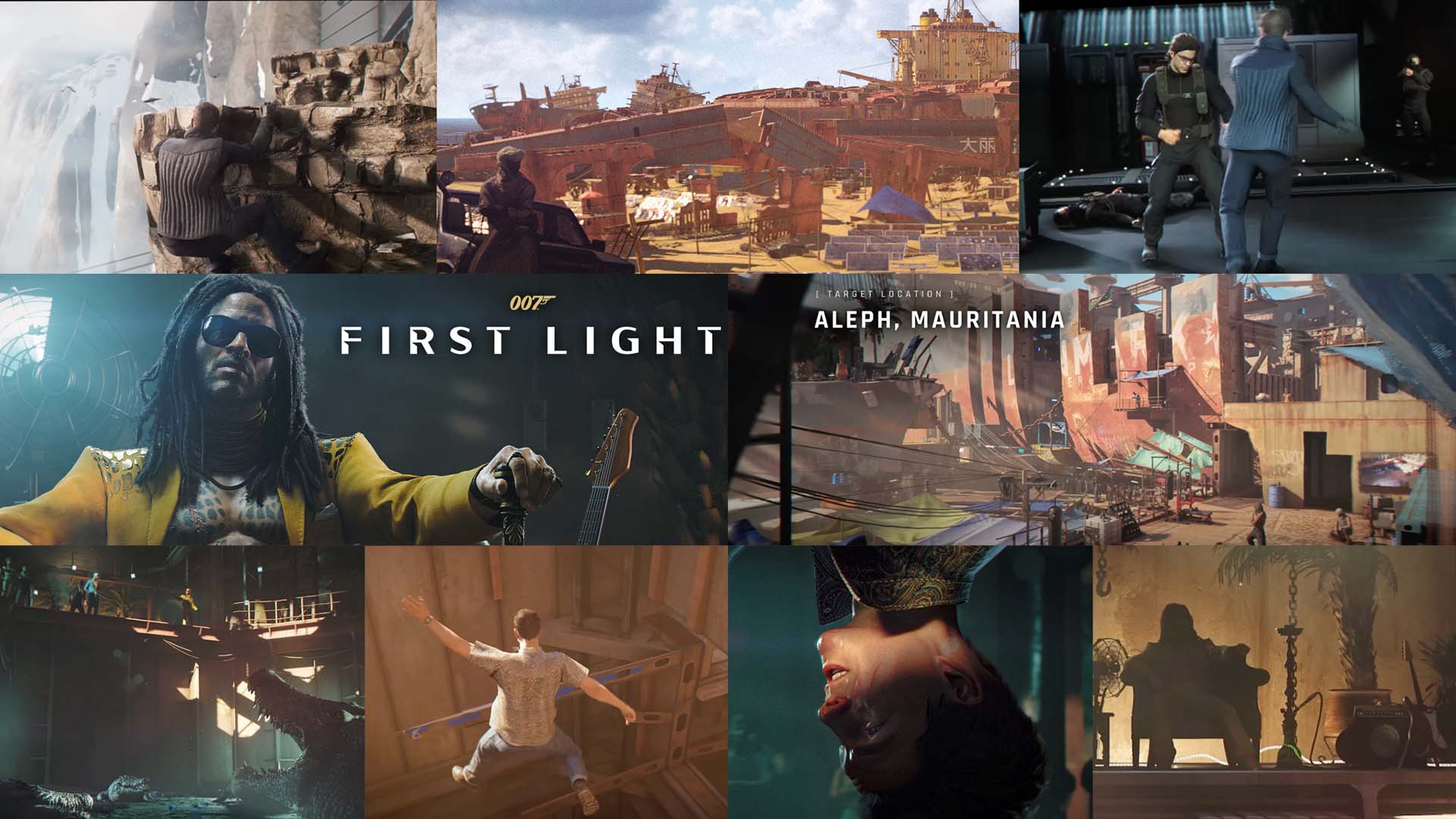
Snow-covered mountains. Warning signs. A city rising from rusted shipwrecks. In just a few short moments, the Bawma Trailer for 007: First Light presents a series of striking images that hint at Bond’s journey, new locations, and the environments he will have to navigate. So what exactly is hidden in this brief trailer? Let’s take a closer look.
The trailer opens with a reworked musical cue that will feel instantly familiar to long-time Bond fans: a variation on the On Her Majesty’s Secret Service theme, reimagined by The Flight. As the music bridges earlier footage from the Reveal Trailer and the Gameplay Trailer, the visuals widen in scope.
Bond is shown jumping onto scaffolding in London, edging along a rock face, moving through the wrecks of Aleph, and later hanging suspended above the crocodile pit alongside Greenway—repeatedly placed in exposed, unstable positions rather than on solid ground.
First Light Snow Gameplay: Is This Really Iceland?
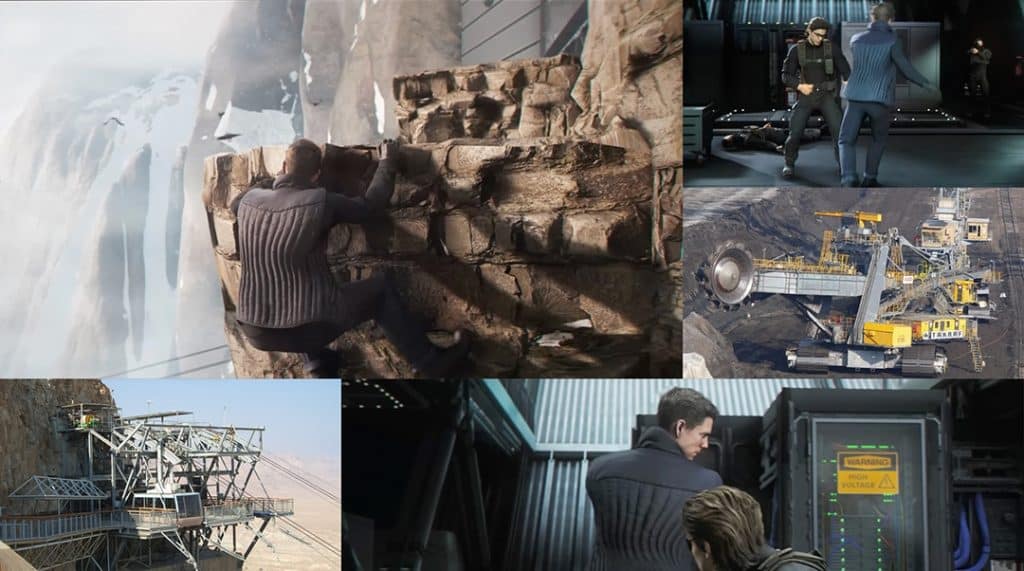
For the first time, we get gameplay in a snowy mountain landscape. A large building sits in the background, with thick cables leading upward—either power lines or perhaps elements of a cable car system. Birds cut across the frame, and it’s hard not to imagine how easily startled wildlife could betray Bond’s position during a stealth approach.
Soon after, the trailer switches to Bond fighting soldiers in close quarters inside a mysterious structure. The interior appears at least two stories high, reinforced by heavy black metal beams—some of which look jointed, almost as if parts of the angled walls could move, fold, or open like ramps. On the floor, multiple red marker lights glow—potentially designed to help identify the end of a ramp from the outside during a blizzard or nighttime conditions.
What is this place? A few plausible options:
- a remote cable car station or industrial facility
- a military outpost designed for extreme conditions
- something far larger and stranger—possibly a mobile structure, even reminiscent of giant industrial vehicles
When One Warning Sign Raises Questions
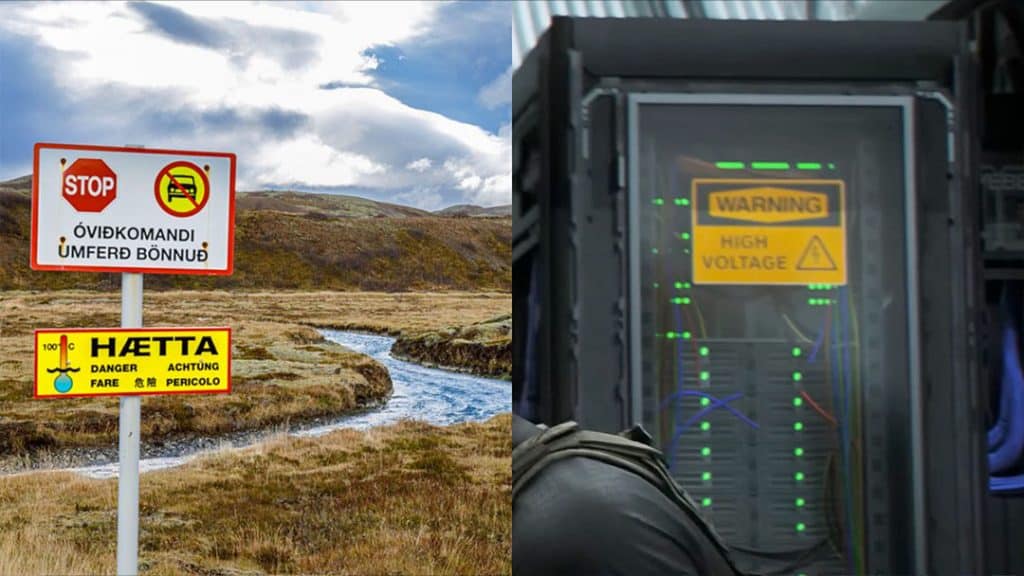
We already know that before joining the 00-program, Bond survived a catastrophic Royal Navy mission in Iceland — a formative trauma in his biography. Many fans hoped Iceland would feature as a playable prologue, but I’ve long suspected something more: that Iceland may also house a key villain location. The clues are there. The antagonist’s mask appears less like a symbolic disguise and more like a protective helmet, possibly designed to shield its wearer from heat or hazardous gases. Combined with the repeated references to obsidian — a form of volcanic glass — a potential connection to Iceland is hard to ignore.
Whatever the facility from the trailer is, it clearly demands an enormous amount of electricity. Bulky switch boxes crackle with visible sparks, and the trailer lingers just long enough on one crucial detail: a warning label reading “Warning – High Voltage.” The text appears exclusively in English, with no additional languages visible.
IO Interactive has already demonstrated in the Slovakia footage that it pays close attention to environmental authenticity, including signage and written language. Road signs, warnings, and small textual details there were carefully localized, reinforcing the sense of a real place rather than a generic setting.
That’s why this detail stands out. Based on available examples, safety signage in Iceland is typically written in Icelandic, often accompanied by additional languages—commonly including English. At the very least, one would expect to see words such as „Aðvörun“ (warning) or „Hætta“ (danger) alongside the English text.
So if this is Iceland, why does the trailer show a plain English warning? A few scenarios could explain it:
- It is Iceland, but the facility is staffed primarily by foreign personnel—possibly connected to Webb Industries?
- IO Interactive intentionally avoids any location-specific language clues in this marketing footage and keeps signage generalized.
- It’s not Iceland at all, but another English-speaking region with similar terrain—such as Canada.
The trailer doesn’t confirm anything—but it clearly wants us to ask the question.
Bond’s Winter Outfit: A Subtle Echo of Spectre
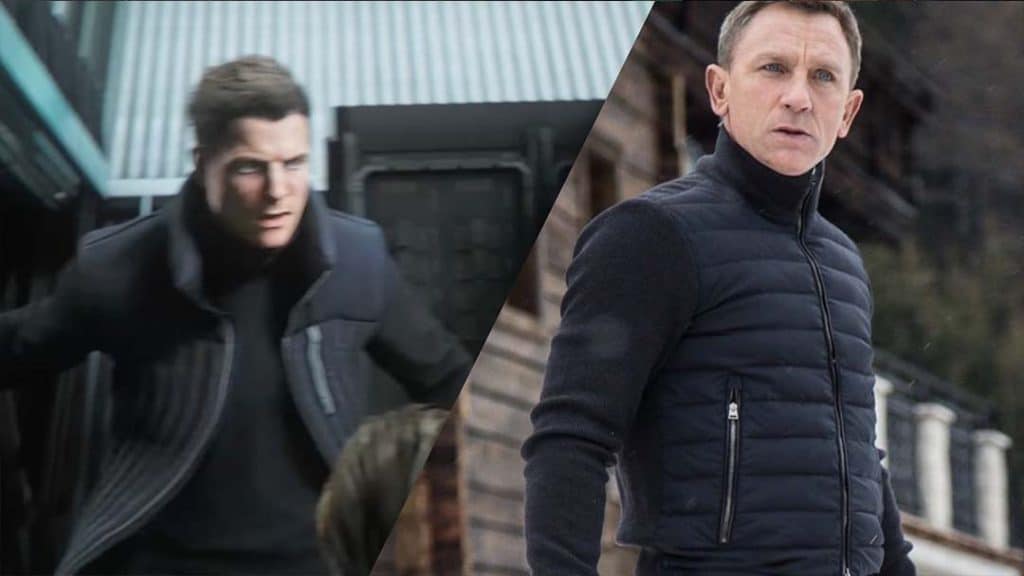
Before we move on, there’s a detail worth calling out: Bond’s clothing. He wears black gloves and a padded outer layer that reads as dark anthracite, sometimes catching a blue tint. It naturally evokes memories of Spectre, where Daniel Craig wore a long-sleeved Tom Ford bomber in cold-weather sequences— but the cut here is different.
This looks more like a vest over a sweater, with insulation wrapping fully around the torso. The padding is separated by vertical stitching, not horizontal. It’s not a copy—it’s a controlled visual rhyme.
Aleph: A Fortress Built Inside a Ship Graveyard
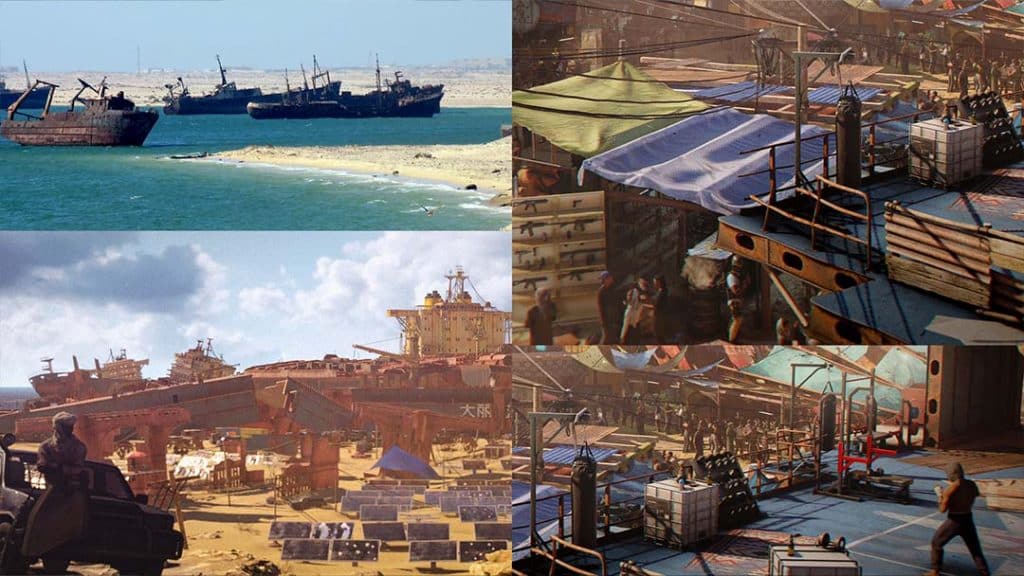
The trailer then introduces a major new destination: Aleph in Mauritania. The city is fictional, but it clearly draws inspiration from a real-world location: the ship graveyard near Nouadhibou, where hundreds of vessels were abandoned over decades in sheltered bays off the Atlantic coast.
The Real Ship Graveyard: A Short History
The ship graveyard near Nouadhibou formed in protected bays, where vessels were shielded from Atlantic waves and currents. For years, decommissioned ships were quietly left to decay. By 2004, more than a hundred wrecks were still visible above the waterline, with many more submerged.
The site expanded rapidly after Mauritania nationalized its fishing industry. Poorly maintained and unprofitable vessels were abandoned, turning the area into a dense mix of fishing boats and occasional naval ships. Despite repair services in Nouadhibou, much of the fleet fell into disuse.
Repeated attempts to remove or recycle the wrecks stalled due to legal disputes and environmental concerns, particularly oil leakage and navigational hazards. European-funded cleanup efforts shifted focus over time, but progress remained limited. By the mid-2010s, access to the area was restricted, while satellite images continued to reveal large numbers of rusting hulls offshore and extreme congestion in nearby fishing harbors.
How the Game Reimagines It
In 007: First Light, Aleph isn’t merely a settlement near wrecks—it’s a city threaded through them. The trailer suggests neighborhoods built around the remains of e.g, giant Chinese and Russian cargo ships, hulls and corridors welded into a towering maze. Outside, a massive solar field provides power, keeping the city independent from its surroundings.
Additional screenshots released by IO Interactive show that Aleph is more than a guarded fortress. Yes, Bawma’s men watch the perimeter with rifles, jeeps, and helicopters—but inside we also see everyday life: a thriving black market with weapon stalls, covered shopping passages, public meeting places, and even an open-air gym. Aleph isn’t just defended. It’s lived in.
A Kingdom of Rust: What IO Interactive Says About Aleph
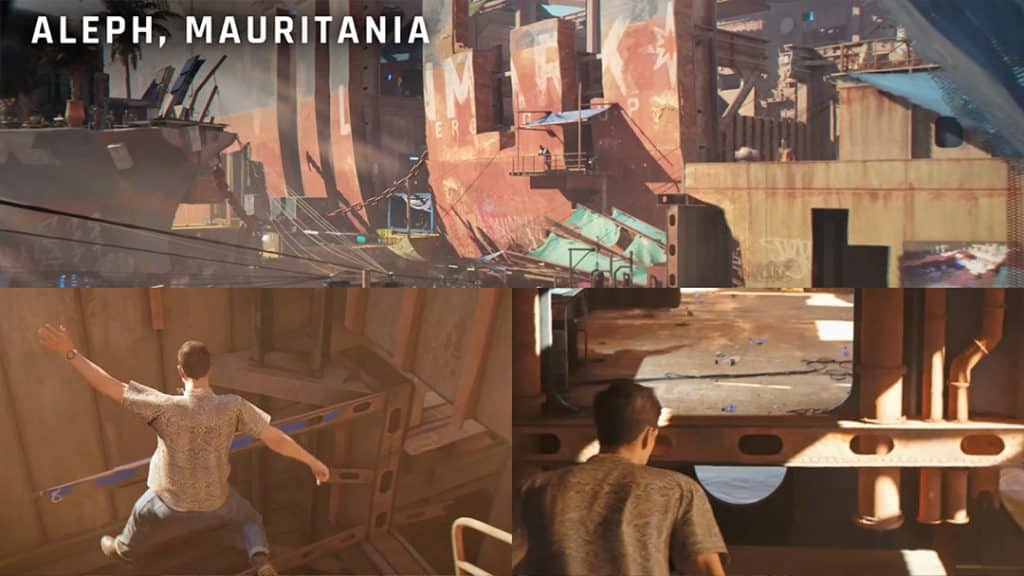
We don’t yet know why Bond and Greenway infiltrate Aleph, but IO Interactive Narrative Director Martin Emborg explained to GameSpot why it’s one of his favorite locations:
“It is a kingdom, and Bawma is its pirate king. Aleph is one of the most dangerous places on Earth. Somewhere where, if you don’t keep your wits about you, you probably won’t make it out. When you first see it, you think it’s going to be a high adventure, but the closer you get, you realize how dodgy it actually is. Then, once you enter it, you think, ‘I should probably not be here.’ It’s really one of my favorite locations in the game.“
Recent interviews also emphasize the feeling of adventure, which makes me think Bond will have room to explore—at least briefly—undercover. But we already know from the Reveal Trailer that a subtle approach won’t hold. Bond ends up fighting, falling, and sprinting through chaos—and in the Bawma footage we see him jumping between ship levels and taking cover under gunfire.
One detail stands out: hints of blue paint appearing on ledges and corridor floors. Is this subtle player guidance? Or simply random color leftover in a patchwork city built from scavenged materials? In Aleph, both feel believable—and that ambiguity is part of the charm.
Bawma: When a Rockstar Plays a Music-Driven Villain
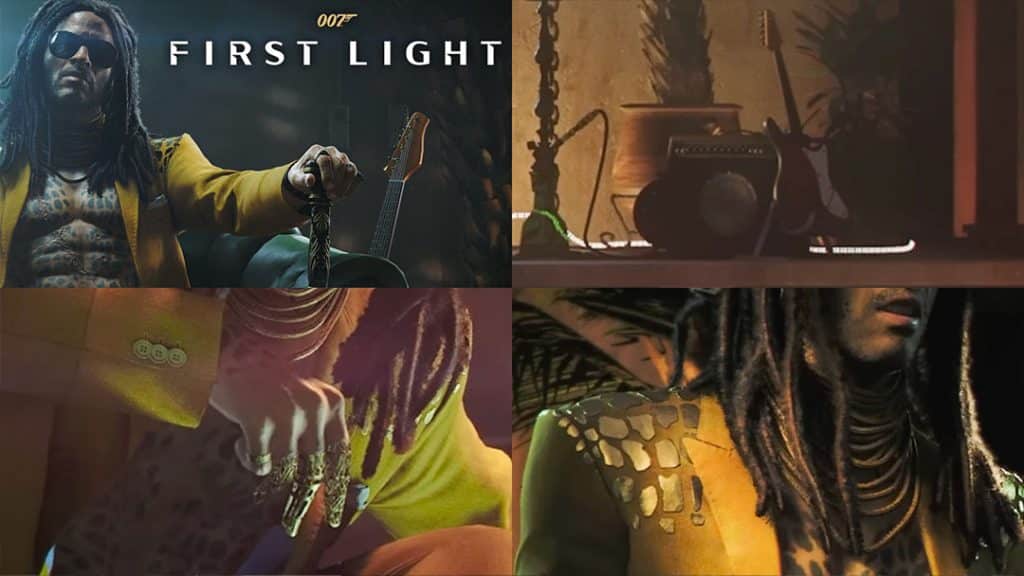
The casting of Lenny Kravitz as Bawma was one of the biggest surprises around the trailer’s release. It’s his first role in a video game—and thanks to Emborg’s comments from a recent Gamespot interview, we know Kravitz had real creative influence on the character. Outfit decisions, personality traits, and elements of the backstory were shaped collaboratively.
Bawma’s rise is framed as almost mythic: he climbed the black market ladder at the age of 17 and laid the foundations for Aleph. Now he rules it as the head of a massive smuggling network.
Bawma’s Body Language: Scars, Scales, and Gold
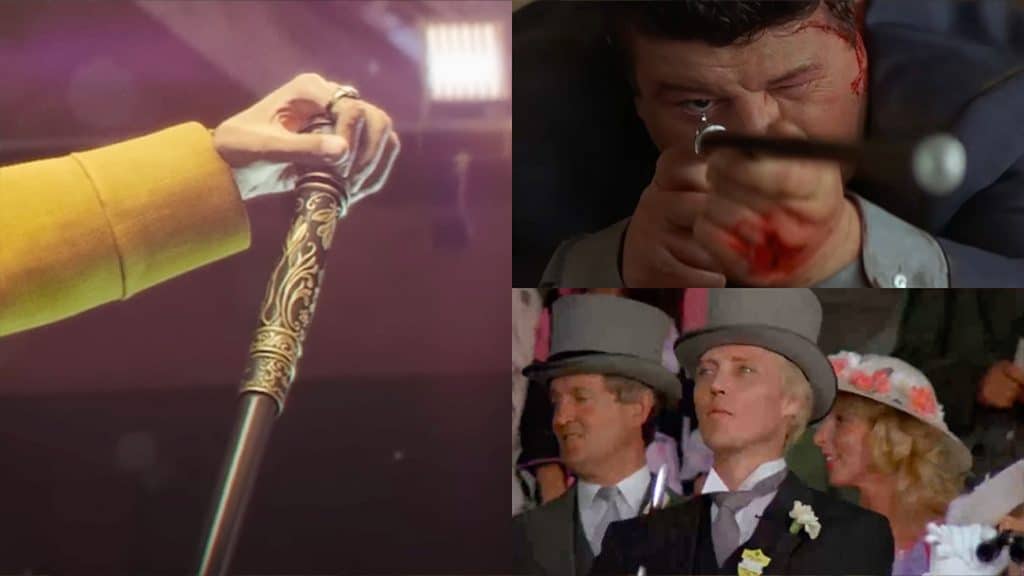
Top right image featuring Valentin Zukovsky from The World Is Not Enough (1999) © EON Productions / MGM.
Crocodiles appear central to Bawma’s identity. We see reptilian scale patterns on his suit shoulders, crocodile-scale tattoos on his hands and across his chest, positioned alongside old gunshot and knife scars. His right hand wears gold adornments that cover parts of the fingers—luxury, symbolism, or even prosthetics after a violent encounter?
He enters with a cane—slow, theatrical, controlled. It may simply serve the trailer’s drama, but it could also hint at a leg injury. In the Bond universe, however, canes have a history of being more than walking aids. Max Zorin, the antagonist in A View to a Kill, concealed a remote control inside his cane to manipulate his racehorse, while Valentin Zukovsky, introduced in GoldenEye and later returning in The World Is Not Enough, famously hid a small pistol in his cane—an improvised gadget that ultimately helped Bond escape. With that tradition in mind, Bawma’s cane may not be purely ornamental.
The “Girls”: Crocodiles as a Bond Motif
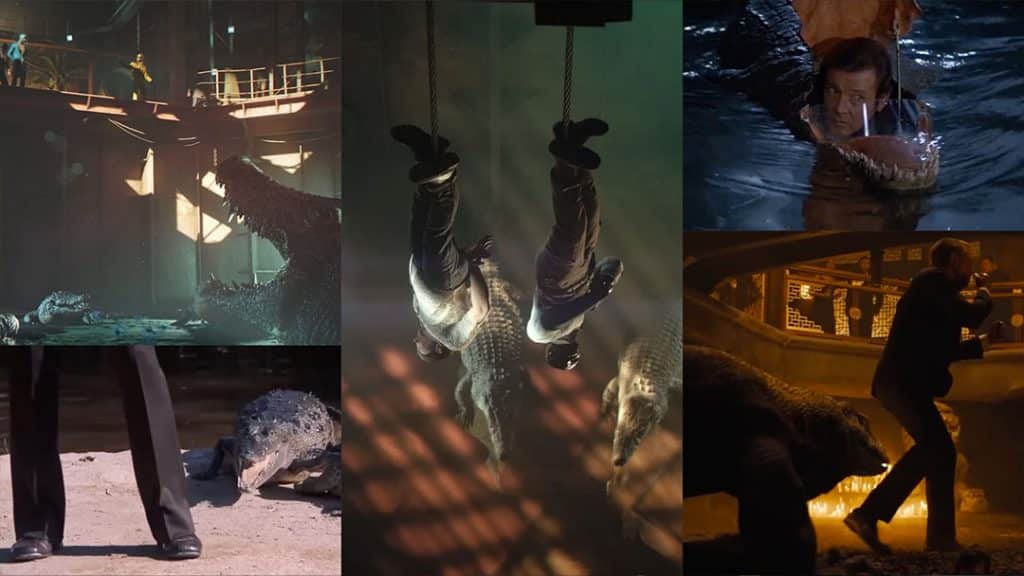
Top right image from Octopussy (1983); bottom left image from A View to a Kill (1985); bottom right image from Skyfall(2012) © EON Productions / MGM.
Large reptiles are hardly new territory for Bond fans. Over the decades, Bond has crossed paths with them in very different contexts: from the infamous crocodile escape in Live and Let Die, to the disguised crocodile-shaped boat used for infiltration in Octopussy, and later the tense encounter with a Komodo dragon in Skyfall. These moments turned reptiles into recurring signposts in Bond’s world, often marking the point where calculated risk gives way to real, immediate danger.
In the Bawma Trailer, that idea is taken several steps further—both narratively and visually. Based on their form and apparent size relative to Bond and Greenway, the crocodiles are most likely Nile crocodiles: huge, aggressive, and among the most dangerous animals in Africa. The line about them being “girls” gets a brief laugh, but it also hints at careful handling, as females can be more manageable together in captivity while remaining highly dangerous predators.
What makes the scene particularly effective is how it is staged. The pit doesn’t resemble a permanent enclosure; it feels ceremonial—less zoo, more arena or courtroom. A man is thrown in to be fed to the animals as Bawma describes Aleph an extension of his own body. The implication is unmistakable: the victim was an “infection” that had to be removed. Whether he was an MI6 contact who failed Bawma’s test, or a genuine threat to his operation that Bond uncovered despite lingering mistrust, remains unclear.
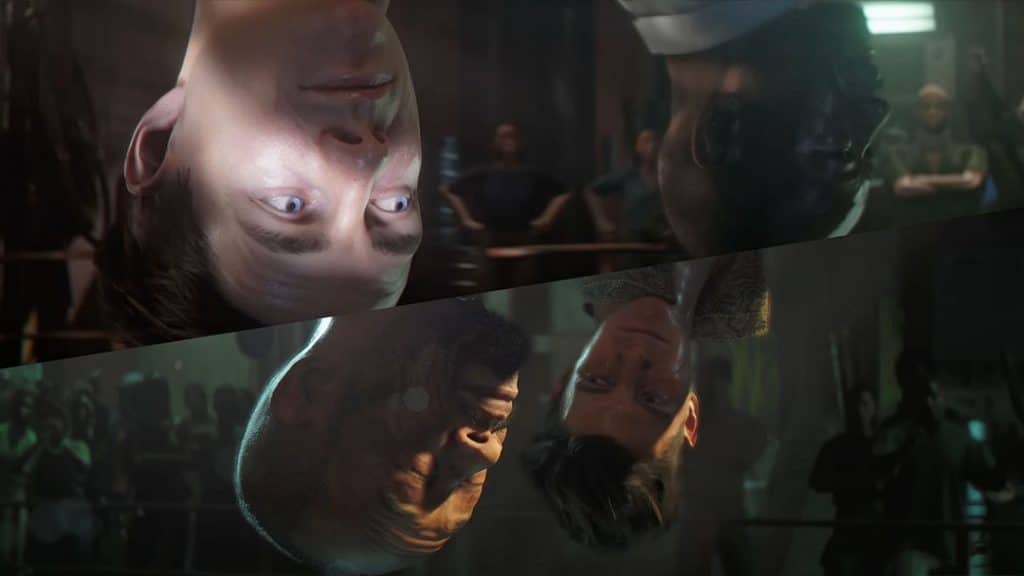
Bond and Greenway, meanwhile, don’t fall in immediately. They are left hanging above the pit, suspended between survival and death, as if awaiting judgment. Visually, this moment stands out as one of the trailer’s most refined sequences: the lighting feels more natural and dramatic than before, Bond’s hair hangs downward under gravity, the stitching on his shirt is clearly visible, sweat gathers on the skin, and even subtle facial deformation reacts to the strain. It’s a clear example of how a moment first introduced as CGI in the Reveal Trailer has now been fully realized in-engine.
Their exact relationship with Bawma remains unresolved, but official IO Interactive text (later removed) suggested that he may blur the line between ally and adversary. In classic Bond fashion, the crocodiles aren’t just a threat—they’re part of the negotiation.
Will Lenny Kravitz Sing? Probably—Just Not How You Expect
When the Bawma trailer briefly leaked via the official 007 channel, I hoped for something bold: a live performance by Kravitz at The Game Awards. It would have been the perfect platform for a title song or a major musical reveal.
But looking at Kravitz’s career, he tends to keep acting and music separate. Even in films where he appeared—The Hunger Games, Precious, and The Butler—he never stepped behind the microphone for the soundtrack as a vocalist. In the case of The Butler, he contributed behind the scenes (writing, arranging, producing), but the vocal performance came from Gladys Knight.
So will his voice remain silent in 007: First Light? I don’t think so. The key is that IOI is clearly framing Bawma as a musician inside the world. In his Aleph palace we see instruments—an electric guitar, an amplifier, a drum—and the trailer’s key art places a guitar beside him.
That points to in-universe music: songs that exist within Aleph, perhaps played through speakers, used as atmosphere, propaganda, or the pirate king’s own calling card. It’s closer in spirit to Underneath the Mango Tree from Dr. No—a track written specifically for the film and first introduced during Bond’s iconic beachside encounter with Honey Ryder. The song is presented as part of the scene itself and later reprises instrumentally in the score, reinforcing its connection to place and character. While Honey Ryder appears to sing it on screen, the vocals were actually performed by Diana Coupland, not Ursula Andress.
And it aligns perfectly with what IO Interactive’s audio & missions director Dominic Vega told Eurogamer:
“The soundscape will also reflect Bond’s globetrotting – you’ll hear in-universe music appropriate to wherever he finds himself, including licensed tracks. Dialogue will also reflect where you are in terms of the use of language and the accents you’ll hear.“
If that’s the plan, Kravitz may not headline the soundtrack in the traditional sense—the title song may well belong to someone else, perhaps even Lana Del Rey. Bawma’s music, however, could still become part of the game’s identity, woven into Aleph’s streets and into Bond’s most dangerous encounters.
Taken together, the Bawma Trailer reveals just enough to spark questions without answering them—about locations, characters, and the forces shaping Bond’s path. Which moment or detail caught your attention most, and what’s your leading theory after watching the trailer?
Source:
Gamespot.com – 007: First Light Knows The Key Ingredient To A Great James Bond Adventure