Life-size promotional figures were a familiar sight alongside video game and film releases for many years. Whether displayed in electronics stores, specialist retailers or at trade shows, their purpose was always the same: to capture attention and bring iconic digital characters into the real world. Behind many of these figures stands a German company: Muckle Mannequins GmbH.
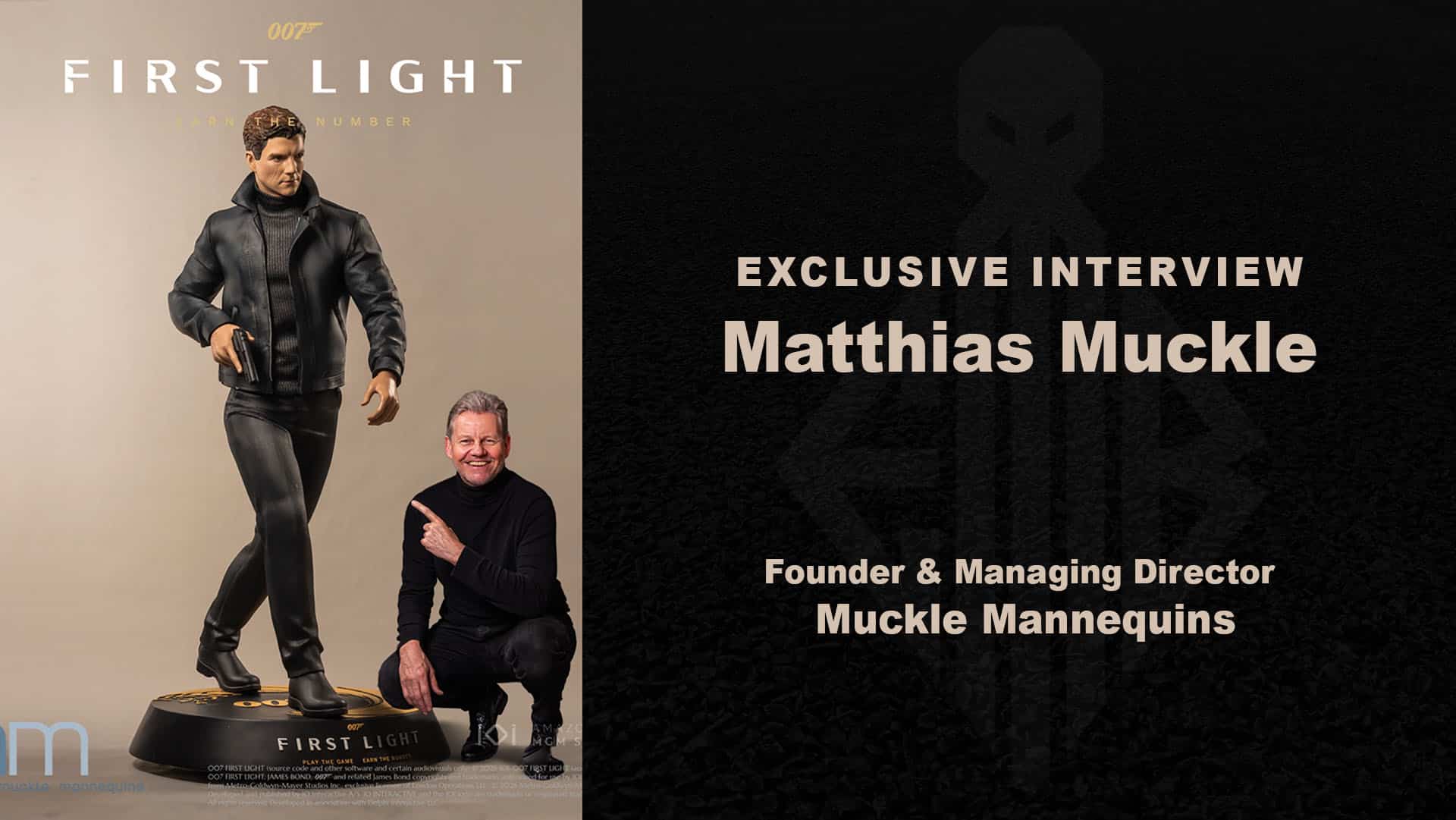
For 007 First Light, the company produced a life-size James Bond figure that would accompany the game’s marketing campaign for several months. It made its first public appearance at the IOI Access event surrounding The Game Awards in late 2025. International preview events for press and content creators followed before the figure eventually appeared in selected retail stores around the world shortly before launch.
Matthias Muckle, Managing Director of Muckle Mannequins GmbH, spoke with us about the company’s unusual beginnings, its long-standing collaboration with Studio Oxmox, the transition from hand-sculpted prototypes to modern 3D workflows, and the meticulous process of creating a figure designed to bring James Bond from the game world into reality.
For me, the conversation also revealed an unexpected connection to a chapter of video game history that dates back almost twenty years.
From Rotisserie Chicken to Lara Croft
The story of Muckle Mannequins begins in an unexpected place—far removed from video games or movie characters.
Matthias Muckle originally came from a family that operated a construction materials and natural stone business. After completing his vocational training as a wholesale merchant, he spent around ten years working as a stonemason in production, gaining hands-on experience with shapes, materials and surfaces. At the same time, he developed an early interest in model making—skills and passions that would later prove invaluable in the creation of display mannequins and promotional figures.
His father later founded an import and export company. One of the firm’s business partners operated a chain of rotisserie chicken restaurants in the Czech Republic, and Muckle himself became involved in running one of the locations for a time. Through the same contact, he was introduced to the production of retail mannequins. After visiting a factory in the Czech Republic, he brought several mannequins back to Germany, but was disappointed by their quality.
Rather than settling, he boarded a plane to the Far East in search of better manufacturers. After visiting several factories, he found a production partner he continues to work with to this day. Both the company’s retail mannequins and its later promotional figures are still manufactured there today.
Retail mannequins became the foundation of his business. The idea for life-size promotional figures, however, would emerge only a few years later—and surprisingly, it all began with a music video.
When Matthias Muckle watched the music video for Männer sind Schweine by the German rock band Die Ärzte (see video above), one particular detail caught his attention. Fittingly, given the song’s satirical take on male stereotypes and chauvinism, Lara Croft appears throughout the video. At the time, she was one of the most recognisable sex symbols in gaming. But rather than serving as mere decoration, she confronts the band members at gunpoint, becoming one of the video’s defining characters.
The music video was released in 1998—three years before Lara Croft made her big-screen debut alongside Angelina Jolie in Lara Croft: Tomb Raider (2001). For many people, the character still existed almost exclusively on a computer monitor or television screen. Yet in the music video, Lara Croft suddenly stood shoulder to shoulder with real people.
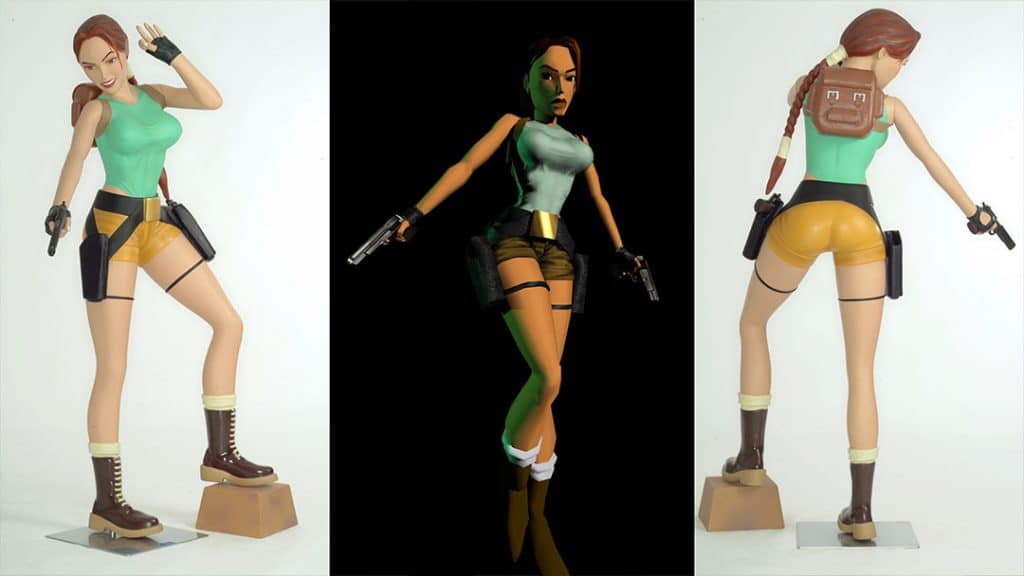
By that point, Muckle had already gained experience with retail mannequins and understood how much attention a striking visual display could attract. Seeing Lara Croft in the music video sparked an idea. Instead of meeting players only on game boxes or television screens, the famous archaeologist could welcome fans in person—in stores, at trade shows and during promotional events.
To turn that vision into reality, he contacted Eidos Interactive in Hamburg, then the publisher of Tomb Raider. They referred him to a model maker in Cologne: Marc Klinnert of Studio Oxmox.
That first conversation led to a partnership spanning more than fifteen years, during which Studio Oxmox and Muckle Mannequins created numerous promotional figures for the video game industry.
Of Clay, Polystyrene and a Washing Machine on Two Legs
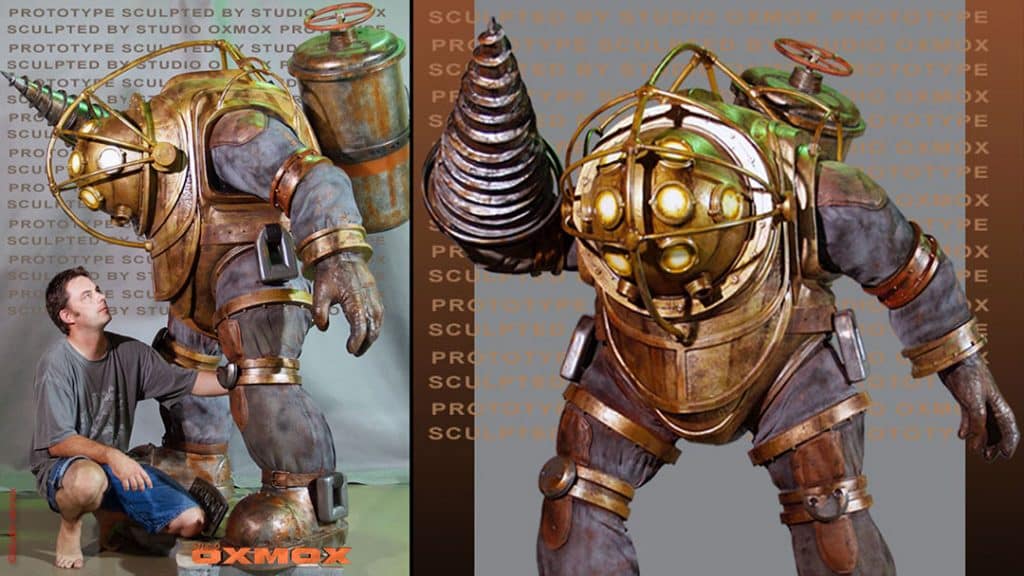
While Muckle Mannequins handled production, the original prototypes were created at Studio Oxmox. Marc Klinnert had built a reputation as an illustrator, designer and model maker, with each figure traditionally sculpted from clay, polystyrene and a variety of modelling materials.
One of the many figures born from the collaboration between Studio Oxmox and Muckle Mannequins was the Big Daddy from BioShock—one of my favourite video games of all time.
When I asked Matthias Muckle about the figure, he immediately remembered the iconic protector of the Little Sisters.
“That’s the washing machine on two legs,” Muckle laughs. “It was an incredibly large figure and, looking back, quite a risky project because we didn’t yet have much experience with constructions of that size. It had enormous volume, and today I would build it very differently.”
Almost twenty years ago, I worked as a community moderator for the BioShock series at 2K Games and, as a devoted fan, ran the private blog Rapture Gazette. While working on an article about the creation of the original BioShock promotional figures, I interviewed Gaby Klinnert, who, together with her husband Marc Klinnert, was behind Studio Oxmox.
Only while researching this article did I realise that Muckle Mannequins had already been involved in bringing many of those figures to life. Nearly two decades later, the story has unexpectedly come full circle for me as well.
Over the years, however, the industry changed fundamentally. More and more stages of production moved from the sculptor’s workbench to the computer. What once began as handcrafted models now starts as a digital 3D sculpture.
For Muckle, the quality of a figure begins long before it reaches the workshop. In his view, the final result is often determined during the earliest stages of digital sculpting. Facial structure, clothing, surface details and proportions all have to be right from the very beginning.
According to his experience, that requires true specialists at the top of their field.
“In the end, the printer simply reproduces exactly what was sculpted beforehand.”
Any mistakes or inaccuracies made during modelling cannot simply be corrected later.
Rather than relying on generalists, Muckle Mannequins now works with a small network of internationally connected 3D artists whom Muckle has come to know over many years through online platforms and joint projects. Some specialise in heads and facial features, others in hands, clothing or complex body anatomy.
Although the tools have changed dramatically over the years, the goal has remained exactly the same: to transform a drawing or digital character model into a figure that looks as though it could come to life at any moment.
A Licence to Sculpt
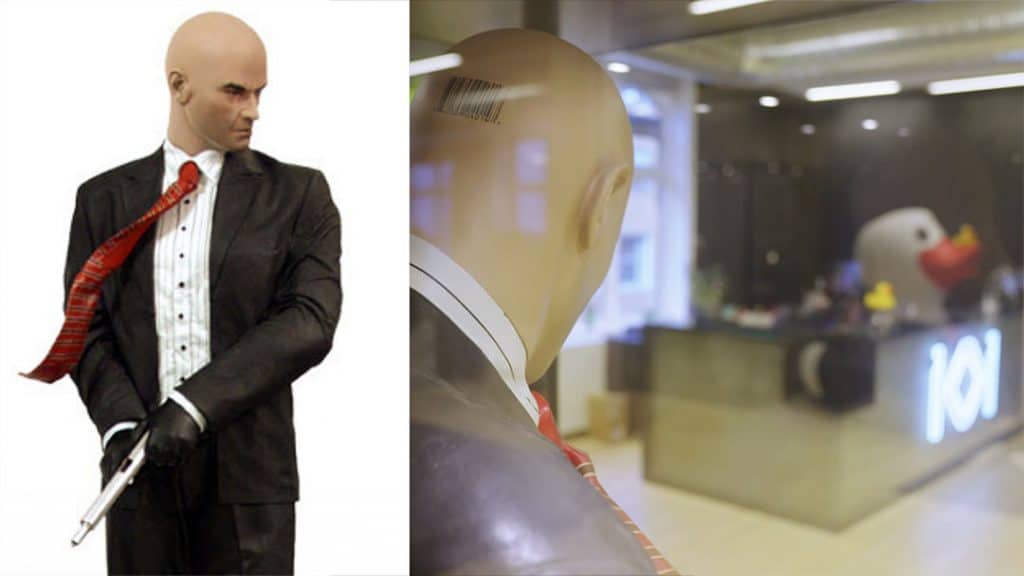
Muckle Mannequins‘ collaboration with IO Interactive did not begin with James Bond. Back in the earlierHitman days, the company and Studio Oxmox had already produced life-size Agent 47 figures—some of which still stand in the IOI offices today.
For Matthias Muckle, however, this project carried a special significance. Creating the first James Bond figure for 007 First Light marked a personal milestone: translating one of popular culture’s most iconic characters into a physical form while meeting the exceptionally high expectations that come with a franchise renowned for its authenticity and attention to detail.
As a result, the development process proved to be remarkably elaborate. From the initial concepts to the finished figure, the project took almost nine months to complete.
Like many modern video game productions, the work began with digital character assets and extensive reference material provided by IO Interactive. Alongside the character model itself, the artists received high-resolution references for Bond’s clothing and equipment, including his trousers, sweater, jacket and weapon.
Even so, producing a figure is far more involved than simply printing an existing model. Before materials, moulds or manufacturing could even be considered, the team first had to define the character’s overall appearance. How should Bond stand? Should he be holding a weapon or a flashlight? Which pose best captures the character?
One of Muckle’s artists created a series of 2D concept illustrations exploring different poses, accessories and overall visual impressions.
One detail that was decided early in development was the inclusion of the OMEGA Seamaster Diver 300M Chronograph 007 First Light. From the planning stage onward, it was intended that five selected Bond figures would wear the watch, with OMEGA supplying the pieces specifically for that purpose.
These were a special version of the watch. Externally, they were identical to the retail model but had been produced without a movement, allowing them to serve as authentic accessories for the promotional figures.
As a precaution, Muckle Mannequins had also modelled and 3D-printed its own version of the watch in case the project’s requirements changed during production. In the end, however, the original plan remained unchanged, and the five watches supplied by OMEGA were used.
Only once the pose, facial expression, equipment and overall appearance had all been approved could the actual 3D prototype be developed.
How James Bond Took Shape
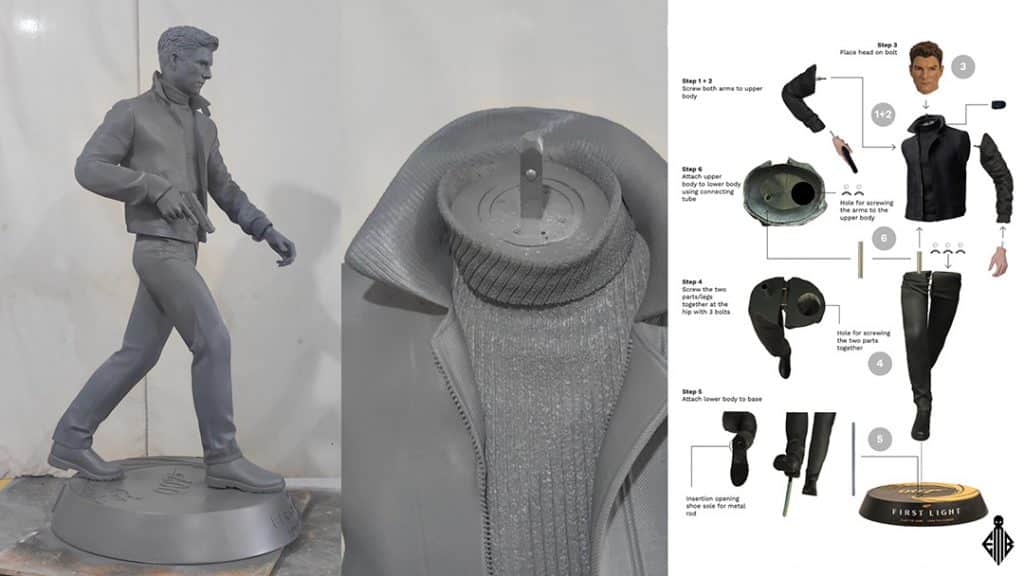
Once the design has been approved, the technical production begins. The prototype is first divided into individual components and printed separately: the right arm, left arm, head, torso, legs and shoes.
These printed parts are not intended for the final display, however. Instead, they serve as master models for the next stage of production: creating the moulds from which the final figure components are manufactured.
To achieve this, each printed part is cast in silicone. The inner layer of the mould is made from silicone, while the outer supporting shell consists of fibreglass.
A single Bond figure requires at least thirty mould sections, which together are assembled from roughly seventy to one hundred individual mould components. This complexity is necessary to ensure that the finished parts can later be removed from the moulds without damaging either the mould or the component itself.
Even at the mould-making stage, the engineers determine how every part of the figure will eventually fit together. Mounting points and connection systems are planned from the outset before square locating pins, bayonet fittings and threaded joints are incorporated into the final construction.
The figure itself is then produced using a hand lay-up fibreglass process. First, the silicone moulds are coated with polyester resin. Several layers of fibreglass matting and additional resin are then applied until the material reaches a thickness of approximately four to five millimetres. The finished figure is therefore both highly durable and hollow on the inside.
After the parts are removed from the moulds, each component is trimmed, sanded, primed and carefully sanded once again.
Only then does the final paint application begin.
At this stage, great care is required. Because the silicone moulds capture extremely fine surface textures, excessive sanding would destroy precisely the details that make fabrics, stitching, leather and other materials appear convincing on the finished figure.
The stages of mould making, production, assembly and painting alone take approximately six mont
Mr. Kiss Kiss Bang Bang
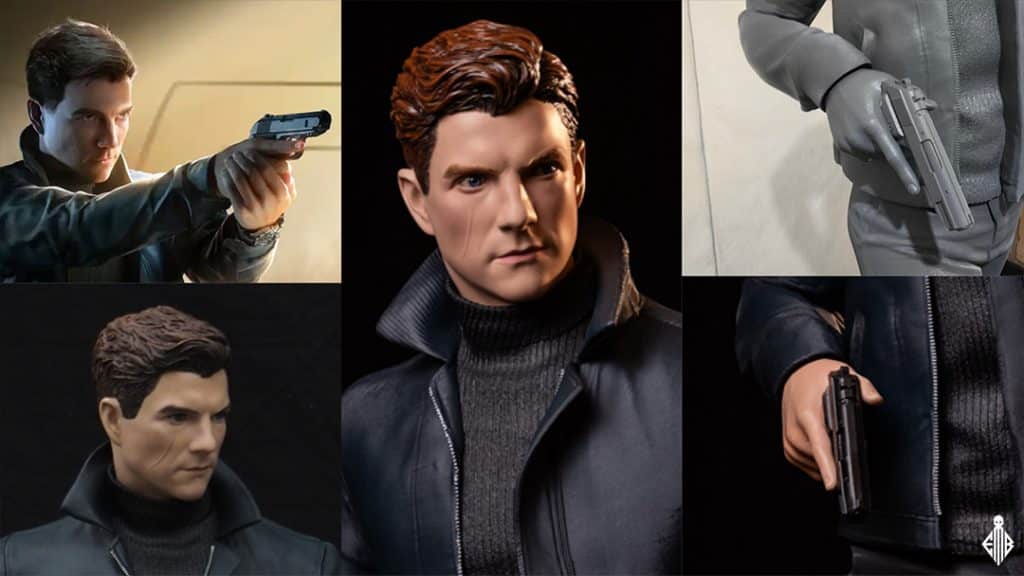
The face received particular attention throughout the project.
When creating the Bond figure, Muckle Mannequins did not base the likeness on Patrick Gibson as an actor. Instead, the team worked from the official 007 First Light character references provided by IO Interactive. The objective was therefore not to recreate an actor, but to faithfully reproduce the exact version of James Bond created specifically for the game.
Bond’s distinctive scar, in particular, became something of a science in itself. At times it appeared too pronounced, at others too subtle. The team repeatedly refined even the smallest details.
“We very often had to adjust the makeup, as well as details around the eyes and lips.”
Those refinements occasionally led to interesting discussions. Colours that looked perfect on Bond’s digital 3D model did not always produce the same effect on a life-size physical figure. To account for these differences, Muckle Mannequins worked with Pantone colour charts, CMYK colour values, test heads and comparison photography.
Muckle documented multiple colour variations by holding the corresponding references directly against Bond’s head before photographing the results. These images were then sent back to IO Interactive, where both teams evaluated them together. Only through these direct comparisons could they determine which colour tones truly worked on the finished figure.
Muckle is particularly proud of the figure’s face, clothing, weapon, pose and hairstyle. Hair, in particular, is notoriously difficult to reproduce convincingly, as fibreglass can easily appear artificial. A realistic hairline, a carefully sculpted parting and believable hair texture all proved essential.
To achieve the highest possible level of detail, Bond’s head was cast in resin rather than fibreglass. Resin captures even the finest skin textures and pores far more effectively. The same applies to delicate components such as the weapon.
Another important detail is the use of acrylic eyes, which give the figures a far greater sense of realism than the painted eyes commonly used in earlier productions.
“Many people probably won’t notice it immediately, but it makes an enormous difference.”
You Are a Rare Breed, Bond
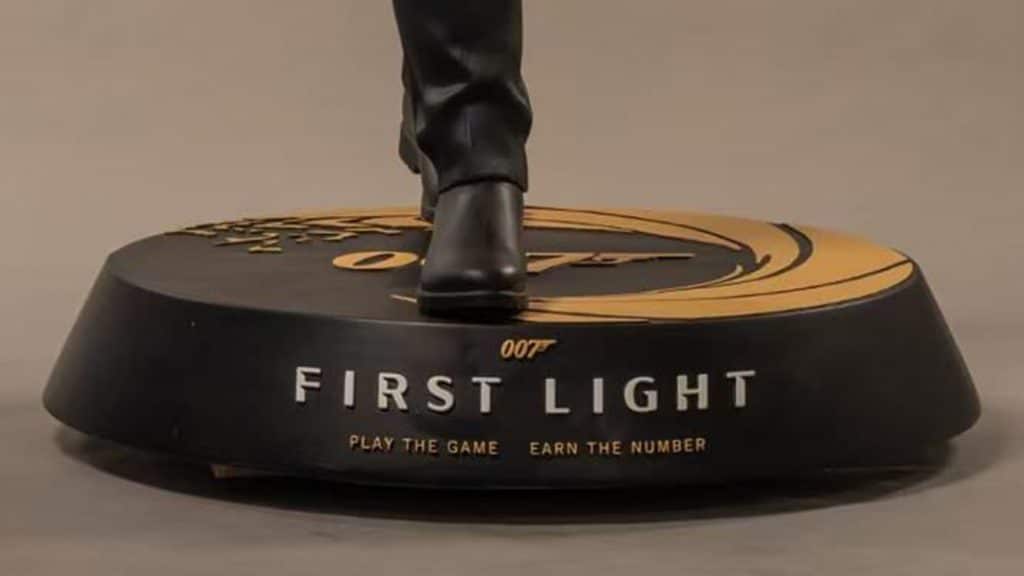
One detail immediately caught my eye in a photograph of one of the Bond figures: the numbering 12/111. Clearly, the figure was part of a limited edition—but why exactly 111 pieces?
Muckle explains that the numbering had to be finalised very early in the project, together with the design of the nameplates. At that stage, nobody knew whether the final production run would consist of 30, 50 or perhaps even 100 figures. To allow for future demand, the team settled on a limited edition of 111.
“At first, we thought there would only be one or two figures. Then it became ten, later fifteen, and in the end we produced around thirty-five.”
Once it became clear that only around thirty-five figures would actually be manufactured, the original numbering was nevertheless retained on the plaques, as it had already been approved earlier in the project.
Ironically, that relatively small production run has since turned the 007 First Light Bond figure into one of Muckle Mannequins’ most exclusive creations.
No Time for the Living Room – Always in His Majesty’s Service
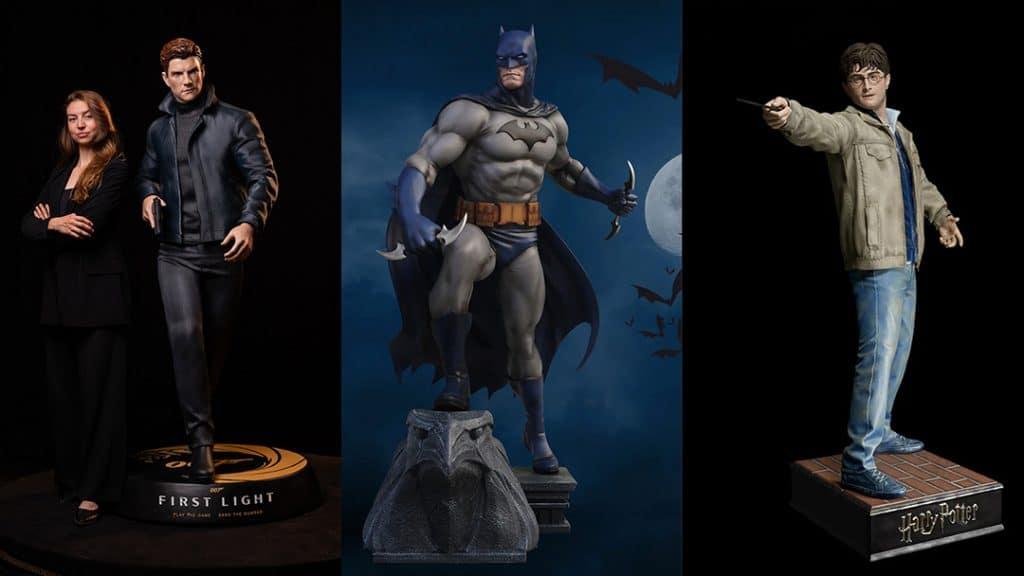
With many of Muckle Mannequins’ earlier productions, private collectors could purchase the figures for themselves. Anyone with enough space—and the necessary budget—could, for example, place characters from the DC Universe or the Wizarding World in their own living room. Depending on the figure, prices typically started at around €4,000.
With 007 First Light, however, the situation is different.
“If IO would like to order additional figures in the future, we’ll be happy to produce them. However, they are not available for public sale.”
The figure will eventually be featured on Muckle Mannequins’ website as a showcase piece, where it will be clearly marked as not available for purchase.
Bond, Brosnan and the Future
For Matthias Muckle, the project also carried a personal significance.
“I always thought Pierce Brosnan was an excellent James Bond. Everybody knows James Bond. I was genuinely excited about this project—I would have been happy to make just five of them.”
After more than twenty-five years in the industry, Bond was simply one of the few major icons still missing from Muckle Mannequins‘ portfolio.
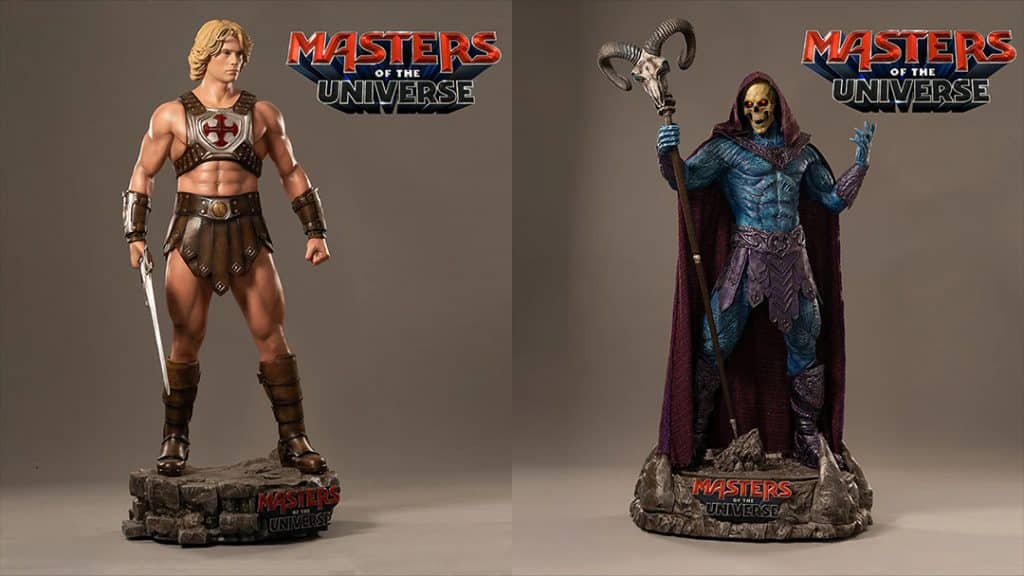
Perhaps this will not be the company’s only mission involving an Amazon MGM property. At the time of our conversation, Muckle Mannequins had also recently completed figures for the upcoming Masters of the Universe film, another production under the Amazon MGM banner.
With the company now overseeing the future of the James Bond film franchise as well, Muckle believes that creating a life-size promotional figure for the next 007 film would be an especially exciting project.
For now, however, the 007 First Light figure stands as the culmination of a remarkable journey: one that began with a rotisserie chicken restaurant in the Czech Republic, continued through retail mannequins, hand-sculpted prototypes in Cologne and manufacturing facilities in the Far East, before ultimately arriving at one of popular culture’s most iconic characters.
It is a journey that began twenty-five years ago with Lara Croft—and has now reached James Bond.
Further information about Muckle Mannequins and its portfolio of life-size figures is available on the company’s official website: mucklevision.com